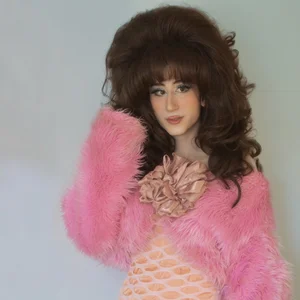
FAQ: “Are you Biologically A Woman?”
I got an email from a window watcher recently, and I thought it was interesting! A woman who I will call Anne Onimus sent in…
“I’m curious to know how long you’ve been doing this for.
Also are you biologically a woman? Or only through surgery? Thank you!”
Yoohoo, Anne! Thanks for looking in my window, and for being curious. Sorry it took me, Flaminia, a while to get back. It’s been a busy busy season, and I wanted to take the time to give this a thorough response. The answers to these questions will probably be longer than you expected. There’s a lot to unpack here. I’ll do my best to give an answer that’s thorough, but still easy to follow along. Anything in bold is a term worth looking into more on your own if you want more information.
First, how long have I been doing this for? There’s a few answers to that, depending on what you meant by “this”. If you meant running a website (which I don’t think you did) the answer is about two years. I started my digital magazina, FAGIOLINA, a few months after at the beginning of 2025. If you meant performing as a queen, I started that nine years ago in a local competition and was absolutely abysmal. However, I first played the role of “Flaminia” a few years prior to that for an acting class project in high school. She’s from Commedia dell'arte, a tangent too long for this article, but worth looking into if you’re interested in theater. And finally, the first time I put on a dress I was a young child. I played the bride in a mock Jewish wedding ceremony at an orthodox summer camp; A story for another time ;)
Next, am I woman biologically or only through surgery? This is a bit of a loaded question, but I can tell you’re asking in good faith. You asked if I was “biologically” or “surgically” a woman, but what I think you’re trying to ask is if I’m a cis or trans woman. The answer to that is neither. Out of drag I am a cisgender gay man. That means I was assigned male at birth, and still identify as a man. A feminine man that occasionally gets mistaken for a woman, but still ¯\_(ツ)_/¯
My drag is a mix of my biology and choices. Many features are natural, some are painted or padded over, and I’ve had lip filler and IPL laser hair removal (not just for drag, but that was a factor).
The mainstream conception of drag is that it’s about men performing as women. This is a category I fall into, but defining drag as this misses what actually makes it interesting. There are women, cis and trans, that perform as drag queens. People of all backgrounds perform as queens, kings, or things beyond that. What we’re all ultimately doing is playing larger than life personas. We’re reclaiming and subverting ideas that have been forced onto us about gender roles. For me, Flaminia, that means getting to be sweet, delicate, and pretty in a way that I felt ashamed of as a child. Even though I’m not a woman, my expression of femininity is earnest, and drag allows that to be celebrated.
The broader conversation that drag elicits is that gender has never been strictly biological, it’s social.
This may seem pedantic, but I think it’s a concept everyone intuitively understands. Sex and gender get used interchangeably, but aren’t the same. Let’s talk about biological sex first, and how it relates to gender.
Humans exhibit sexual dimorphism, physical differences based on sex. We have reproductive systems, and secondary sex characteristics that typically develop relative to our sex (like breasts for women, or facial hair for men). Most of the time, sex is determined by our 23rd pair of chromosomes. Most people inherit an X chromosome from an egg, and either an X or a Y from a sperm cell. People with XX pairings develop as female, and XY develop as male, but there are rare conditions that result in development not following these patterns.
Intersex is an umbrella term that describes a variety of biological exceptions to this pattern. Like Swyer syndrome, where an individual with an XY chromosome is born with a typical vulva. Some intersex conditions result in ambiguous genitals, and this unfortunately often results in non consensual medical intervention to make infants appear more conventional.
Being intersex is not the same as being trans, but the struggles the intersex community face shed light on a shared problem. Gender is compulsory. It’s assigned at birth based on superficial genital presentation. Later in life, a lot of what we associate with gender are secondary sex characteristics that develop based on hormones and genetics. These vary wildly from person to person, and hormones change throughout our lives. The physical ideas of gender are loosely based on wide averages.
Imagine a hypothetical man and woman… what do they look like?
I’m not a psychic (and frankly, neither are psychics), but I’m guessing you’re picturing something like Adam and Eve, or maybe GI Joe and Barbie. I am 100% confident that in your lifetime, you have seen men and women that do not fit these molds. Maybe a woman with a flat chest, or a man wearing nail polish. Some of what we associate with gender has nothing to do with biology at all. There’s nothing biological (or surgical) about names, pronouns, clothing, or makeup despite these all having heavy ties to gender. Toy companies do not market EZ bake ovens to girls and Nerf guns to boys based on biology.
Your original question assumes that transitioning is a matter of getting “the surgery”, which is another common misconception. Transition looks different for different people. There are many surgeries a trans person may get to address specific concerns, like a breast augmentation for a trans woman or a mastectomy for a trans man. There are non surgical gender affirming treatments too, like hormone replacement therapy. Some trans people may opt for both, or even neither. Sometimes gender affirming care just consists of lifestyle changes, like going by a different name and dressing differently. Cis people partake in all of these things to feel more confident in their gender expression too.
Being transgender just means that person does not feel aligned with the gender they were assigned. The choices they make to express that are as personal as the choices everyone makes to present ourselves.
Can you, Anne, think of choices you’ve made to feel more feminine?
Or aspects of conventional womanhood you’ve chosen to reject?
Trans rights affect everyone, because these are issues of autonomy. Everyone should have the right to self actualization. Everyone should be able to feel comfortable in their skin. Everyone should be able to question and reject outdated notions. Thank you, Anne, for asking this question! I answered it as an open blog because I’ve heard similar questions before and figured this would be a nice opportunity to answer some of those too.
There’s a lot of fear mongering, panic, and confusion right now in the media about drag and trans people. It can be complicated, but real life has a lot more hues than pink and blue. While a lot of the language is new and continually evolving, the simple truth is that there have always been people that have not fit inside of these boxes.
I hope this answer was helpful and not too long winded. If you have any follow up questions feel free to ask. My window’s always open <3